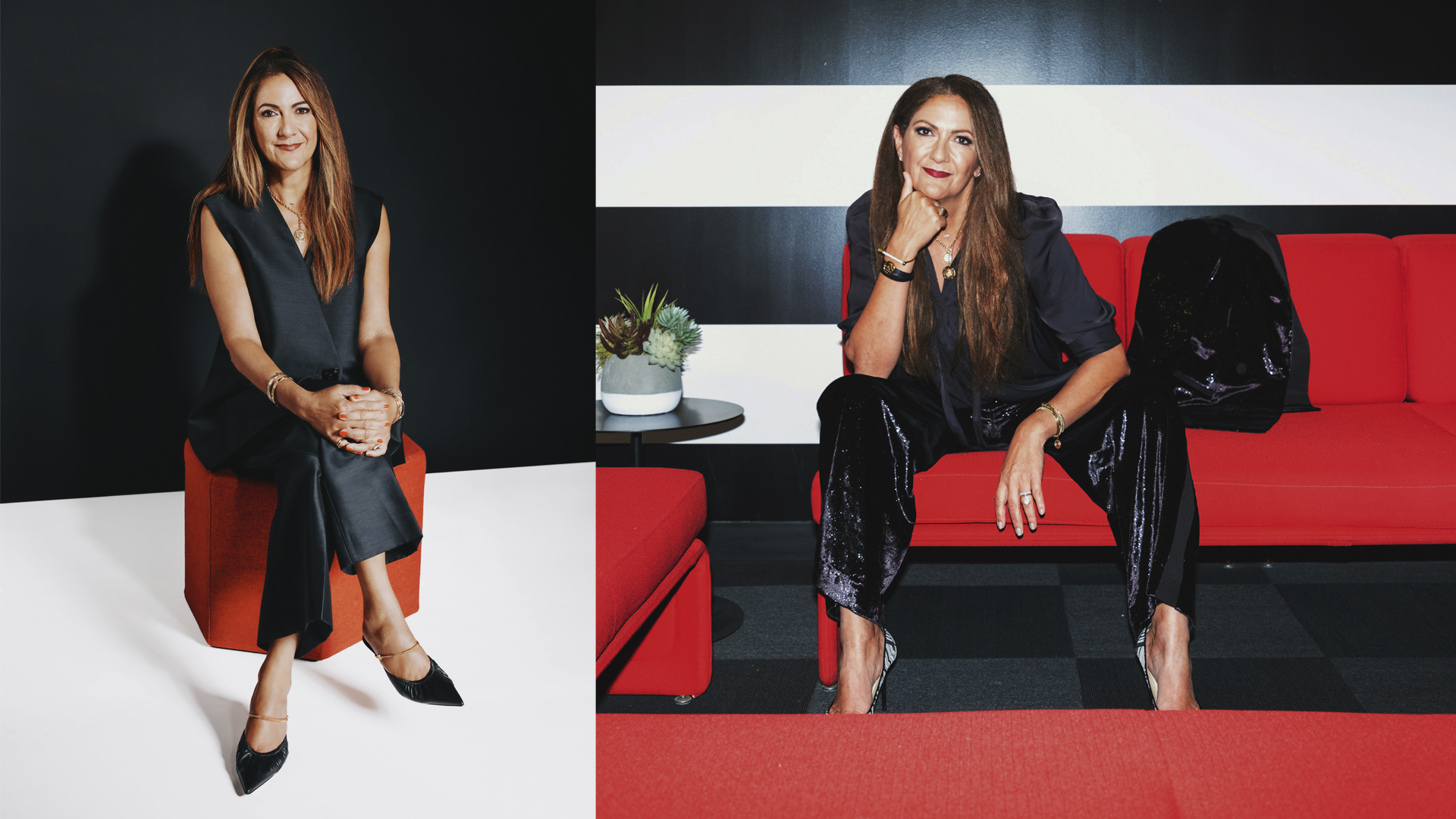
The Sephora North America CEO reflects on how immigration, foster care and an SFSU education helped her craft a life — and a leadership style — of substance and resolve
By Ben Fong-Torres
Artemis Patrick is the subject of a video on Sephora’s YouTube channel. It concludes with her saying, “Everyone has a story.” Everyone may, but none like hers.
Consider: At age 7, in 1979, she fled from Iran during its revolution against the Shah. She arrived in California with no knowledge of English. She was raised by foster parents. While attending UC Santa Cruz, her summer jobs included serving drinks at the Punchline comedy club and taking tourists around Fisherman’s Wharf as a pedicab driver. She earned her MBA in International Business from SFSU in 2001.
Whether by pedicab or personal drive, she is the leader of the biggest retailer of personal care and beauty products. Sephora, which was launched in Paris in 1970 and in America in 1998, has nearly 850 retail stores in the U.S. and Canada, plus more than 1,100 spaces in Kohl stores. Along with 340 brands, it has its own Sephora Collection of products.
Patrick, married and the mother of a 15-year-old daughter, joined Sephora North America in 2006. She was the head of global merchandising when she was appointed president in 2023. The next year, she also was named CEO.
Her achievements have earned her numerous honors, including induction last year into the SFSU Alumni Hall of Fame.
How does a person get from pedaling a pedicab in Fisherman’s Wharf to heading a top-tier beauty retailer?
Patience. That was more than two decades ago, so it does take time.
I think very early on, the pedicab and all those fun little jobs in between college, certainly helped me in terms of business, ethics and work ethic, and showing up on time. But all those [experiences led to] getting a very entry-level retail job, and then just finding my love of retail, and then spending two decades working my way through retail. And I would say, San Francisco is a small city in many ways, and everybody knows everybody, especially in the retail sector.
[It was a time of] working hard and making sure I always led in a way that I felt proud of and had a reputation that I was proud of. I do think it’s important to lead ethically, and word gets around fast.
I started in retail. I was working for a very small catalog company called Celebration Fantastic. We sold everything from Limoges boxes to fun bride and groom hats. And that’s when I fell in love with retail. I decided to go back to school, to start the night school program and get my graduate degree at San Francisco State.
Overall, what did you learn from your time at the universities you attended?
SF State was a different experience because I was working full time and trying to juggle that. I found the flexibility to be able to do that really incredible. I wouldn’t have been able to finish my degree had I not had that flexibility. So I appreciated that there was a program in place for people who were professionals and wanted to advance in their education.
I think the biggest difference, too, at San Francisco State was in my MBA courses. It was beyond helpful in the business setting, right? So you’re working with all different types of personalities, you’re trying to get a group project across the line, everybody works differently. And so I think learning to work with other people versus individually was the biggest difference that I saw between graduate school and undergraduate school.
Was there any particular instructor who stood out in terms of influencing you?
Professor Joel Nicholson. He was my adviser and focused on International Business. He was the one who encouraged me to finish my thesis, about doing business in Italy.
You spoke about your thesis at a conference.
And it was the first time that I had that big of an audience and spoke about something that I’d written, so it was definitely a turning point.
Speaking of turning points, the biggest in your life happened when you were a 7-year-old child. What are your main recollections about that period in the late ’70s, when because of the circumstances of your family and the Shah, you had to flee Iran. What comes to mind when you think back to those times?
What I remember very vividly is the protests in the streets against the Shah, who we knew, because my father was one of the pilots for the government. So watching this outrage against someone who we knew, and not fully understanding what that meant. And then, very quickly after that, having to leave … with my mom. It was just my mom. My dad came later, with really nothing but a suitcase, coming to Los Angeles. I didn’t speak English, so my experience with it is what I saw and what my mother would translate for me. But my understanding at the time was that it was temporary, that we were leaving. [I had] this feeling of, “This is just a temporary thing,” and not fully understanding the impact that it was going to have in my life.
You wound up in foster care. You have credited your foster parents for your success. Did they influence you to go to school, or did they influence you to go and find work?
Definitely school. I distinctly remember when it was time to apply for colleges, my foster dad said, “Try for a UC. It’s a no-brainer. You live in California. You’re a ward to the court. You’re going to get financial aid.” So we went through the UC application, and you would just check-mark which city you wanted … and I thought, “What [school] was near the ocean?” I had gone to the Santa Cruz Beach Boardwalk, and I liked it. I thought, “It’s far enough away to get away, but close enough I could drive home.”
How did you get a job at Sephora?
Well, going back to SF State: I was in a class with a woman, and she said, “I work at DFS.” And I said, “What’s DFS?” It’s the Duty Free Shops, which is owned by LVMH, which also owns Sephora. And she said, “We are looking for entry people,” because at the time DFS had moved offices from Hong Kong to San Francisco.
So they had a lot of open planning assistant roles, and I had planning experience. I interviewed to be merchandise planner for tobacco. I think nobody wanted that category. This is now the late ’90s, and it is the explosion of the e-com dot-com boom. And DFS was a pure brick-and-mortar retailer, so I went to Red Envelope, which was a beauty player.
After a few years at other retailers, I reconnected back, through a friend, to an open role at Sephora, in their e-commerce business. And when I went in to meet the head of HR, it was the same person who had hired me at DFS. This is why I say it’s a small town.
In those first 17 years at Sephora, had you felt like you were on the right path for your goals in life?
It wasn’t something I had my eye on. I work for a company that, thankfully, is growing, is very innovative, and there’s always something new. I just really enjoy my day-to-day, and so it wasn’t so much what title am I going to get at Sephora, but that I was at the right company.
You were called a role model for young girls and women, and you’ve said, “Representation is very important to me.”
Definitely, the combination of being an immigrant, growing up in the foster system and showing young girls what is possible … is important. I think that we can feel good that our daughters will actually get it, and they’ll understand it. Unfortunately, the fact does remain that there are not as many female CEOs as there should be.
I’m sure that high-tech and social media have presented you with challenges. Overall, has technology served you well?
We don’t use technology just for the sake of technology … or for buzz or PR. We do things because they make sense for our consumer. I’ll give you an example. About 15 years ago, we started this skin scan technology. It’s called Beauty Scan, and it’s a device that all of our beauty advisers have on their iPhone. It takes a picture of your skin, and it will tell you the right shade of foundation that you should be using; [it] gives you different choices. It gives you the right moisturizer, the right cleanser and things like that. Now, anybody could do something like that and stick it online, right? But what we’ve worked on is that connection between the beauty adviser and the consumer, because it is a conversation.
We’ve done a lot on their handheld devices that gives them information quickly, that gives them training quickly. So how do we use technology to make life easier for our people, as well? And that’s something that I think has been in our blood since day one.